
Every October, Cybersecurity Awareness Month gives security teams something they rarely have: a reason to ask for the company's attention. For four weeks, executives take the meeting. Employees open the email. Budget conversations that stalled in June suddenly move.
That attention is the scarcest resource an awareness program has all year, and October is the one month you get to decide where it goes. Participation runs higher than at any other point in the year, which gives you a four-week window to measure how your whole workforce handles risk, and a hearing for the things you'd struggle to get on the calendar in March.
This guide covers who runs Cybersecurity Awareness Month, what the 2026 campaign asks for, and how to plan the month so what you learn in October shapes the rest of the year.
What is Cybersecurity Awareness Month?
Cybersecurity Awareness Month is a global campaign held every October to raise awareness of online security and move organizations and individuals toward safer everyday habits. It has run every October since 2004, which makes 2026 its twenty-third year.
The campaign runs October 1–31 and addresses the general public. Its materials focus on practical online safety behaviors, including strong passwords, software updates, multi-factor authentication (MFA), and recognizing phishing scams. Its practical weight, though, falls on the organizations that build internal campaigns around it.
For an awareness program owner, that means a ready-made reason to put security in front of the whole workforce. The date is already on the calendar, the campaign materials already exist, and employees are hearing the same online safety messages outside work. October gives the program an opening. What you do with it determines whether it has any value after the month ends.
Who runs it, and what the 2026 campaign asks for
The National Cybersecurity Alliance (NCA) and the Cybersecurity and Infrastructure Security Agency (CISA) co-lead the campaign, and each publishes its own resources for organizations building internal programs.
For 2026, the NCA and CISA have different themes. The NCA focuses on the security decisions people make every day. CISA focuses on the critical infrastructure those decisions help protect.
For a program owner, the difference changes the campaign you build.
- The NCA gives you a behavior-led message for employees.
- CISA gives you an infrastructure-led message for organizations responsible for essential systems and services.
The Core 4 behaviors the campaign is built on
The theme of Cybersecurity Awareness Month changes each year, but the National Cybersecurity Alliance continues to focus on four core security behaviors.
Use strong passwords and a password manager
The action: Use a long, unique password for every account and store passwords in a password manager.
Unique passwords limit the damage if one account is compromised, while a password manager removes the need to create and remember them manually.
For organizations, the next step is adoption. Track enrollment and usage so you know whether employees have actually moved away from weak or reused passwords.
Turn on multifactor authentication
The action: Use multi-factor authentication (MFA) on every account that supports it, at work and at home.
MFA gives an account an extra layer of protection. Even if an attacker gets hold of an employee's password, they still need another form of verification to get in.
The type of MFA matters, too. A code sent by text can still be stolen if an employee enters it on a fake login page. Attackers can also send repeated approval requests to someone's phone, hoping they'll eventually approve one. Some MFA methods, such as security keys and passkeys, are designed to protect against these types of attacks, making them harder for attackers to bypass.
Update software
The action: Turn on automatic updates and install them promptly.
Keeping software current closes known vulnerabilities before attackers can exploit them. Automatic updates make that easier, but only for the devices and software they cover. Personal phones used for work, contractor laptops, and browser extensions can still fall outside the normal update process.
Recognize and report phishing
The action: Learn to recognize scams and report anything suspicious.
The Alliance now words this step as recognizing and reporting scams rather than phishing specifically. That reflects the range of channels employees now encounter. Social engineering and phishing scams can arrive through email, text messages, phone calls, QR codes, and collaboration tools.
Reporting also needs to be easy. Give employees a clear way to flag something suspicious, including when they aren't sure whether it's malicious.
The Core 4 gives every employee a useful baseline, but workplace security awareness training needs to go further. Build on these behaviors with training and simulations based on the risks employees face in their roles. Finance may need to recognize vendor impersonation or cloned-voice payment requests, while IT teams may need to deal with credential theft or help desk scams. These are part of a wider set of human threats that general cybersecurity guidance can't cover in the same depth.
Why the month carries more weight than it used to
Verizon's 2026 Data Breach Investigations Report found a human element in 62% of breaches. But while people are still a major part of the attack path, the attacks reaching them are changing.
Verizon found that attackers are pivoting to mobile-centric social engineering — fake text messages and voice calls — with a success rate 40% higher than traditional email phishing. The report's authors noted that they struggled to find organizations running simulations on those channels at all.
That's the gap to use October for. Look at what your current program covers, then use the extra attention to test where it needs to go further.
For example:
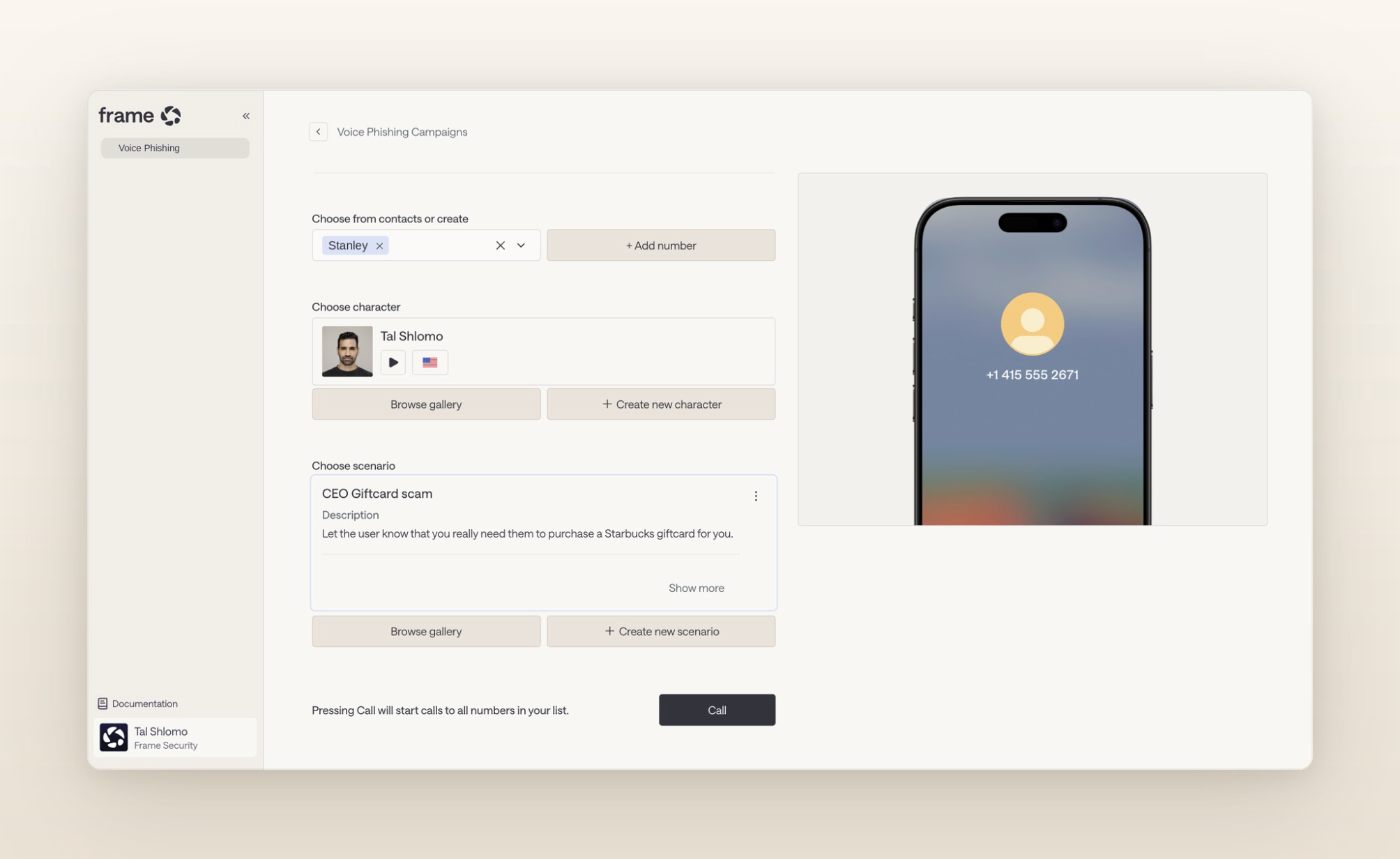
- If your phishing simulations still arrive by email, test another channel, like voice phishing.
- If everyone gets the same security awareness training, use the month to find out which teams need something different.
- If you're teaching employees to spot suspicious links, add the social engineering attacks that don't contain a link at all.
Cybersecurity Awareness Month gives you a reason to ask for attention. It doesn't guarantee you'll get it. But security has a place on the company calendar for four weeks, so use everything available to make the most of it.
The National Cybersecurity Alliance's Cybersecurity Awareness Month toolkit gives you ready-made campaign materials to help get that message out. Use the posters, graphics, and other resources to build visibility around the month, then back them up with your own training, phishing simulations, and other activities that show employees what these threats look like in their work.
How organizations take part
Registering as a Champion is free, and it comes with a toolkit: a tipsheet, eight printable posters, sixteen social media graphics, and sixteen Instagram Story graphics. CISA publishes its own toolkit separately for organizations using its critical infrastructure campaign.
You can use those materials as the starting point for your Cybersecurity Awareness Month campaign.
Before October, decide three things:
- Who owns the campaign. Give one person or team responsibility for planning the month, coordinating activities, and keeping it moving.
- What you want to measure. Choose this before you choose the activities. Depending on your program, that could be phishing reporting rates, password manager adoption, MFA use, simulation results, or another security behavior you want to improve.
- How it connects to the program already running. Cybersecurity Awareness Month should support your existing security awareness training rather than become a separate four-week campaign. Use what you learn in October to decide what employees need next.
There are also events you can build into the month. The Alliance holds a virtual kick-off on October 1, and the NCA Cybersecurity Summit takes place at the New York Stock Exchange on October 22. Frame Security will moderate a session at the summit.
Use the NCA and CISA resources for the broad campaign, then add the training and simulations that make sense for your workforce. The toolkit gives you material to work with. Your own program is where you can make it specific to the risks employees actually face and measure how they respond.
What happens on November 1
When Cybersecurity Awareness Month ends on November 1, the extra focus on security ends with it. The posters come down, the campaign emails stop, and employees get back to business as usual.
Employees won't remember everything they learned in October. How quickly a one-off campaign decays depends on what happens afterwards. Regular reinforcement helps keep security behaviors fresh and gives employees more chances to practice them.
October also tells you something about how your workforce responds to risk. By the end of the month, you should have a clearer picture of:
- Who clicked, reported, or ignored a simulated attack.
- Which teams struggled with particular types of phishing or social engineering.
- Where there are gaps in security behaviors such as MFA or password manager use.
- Who needs more training, and on what.
Use that information to plan what happens next. A finance team that struggled with a cloned-voice payment request needs something different from an IT team targeted with credential theft. Your November training should reflect what you learned in October.
Use October to shape the rest of the year
Frame Security helps you use what you learn during Cybersecurity Awareness Month to decide what to test, train on, and measure next.
- Start with the October kit. Frame's free Cybersecurity Awareness Month kit includes security posters and video backgrounds, daily mini-games with a company leaderboard, and an interactive breach investigation your team works through as a case. It comes with a week-by-week plan for October, and it runs alongside whatever awareness program you already have.
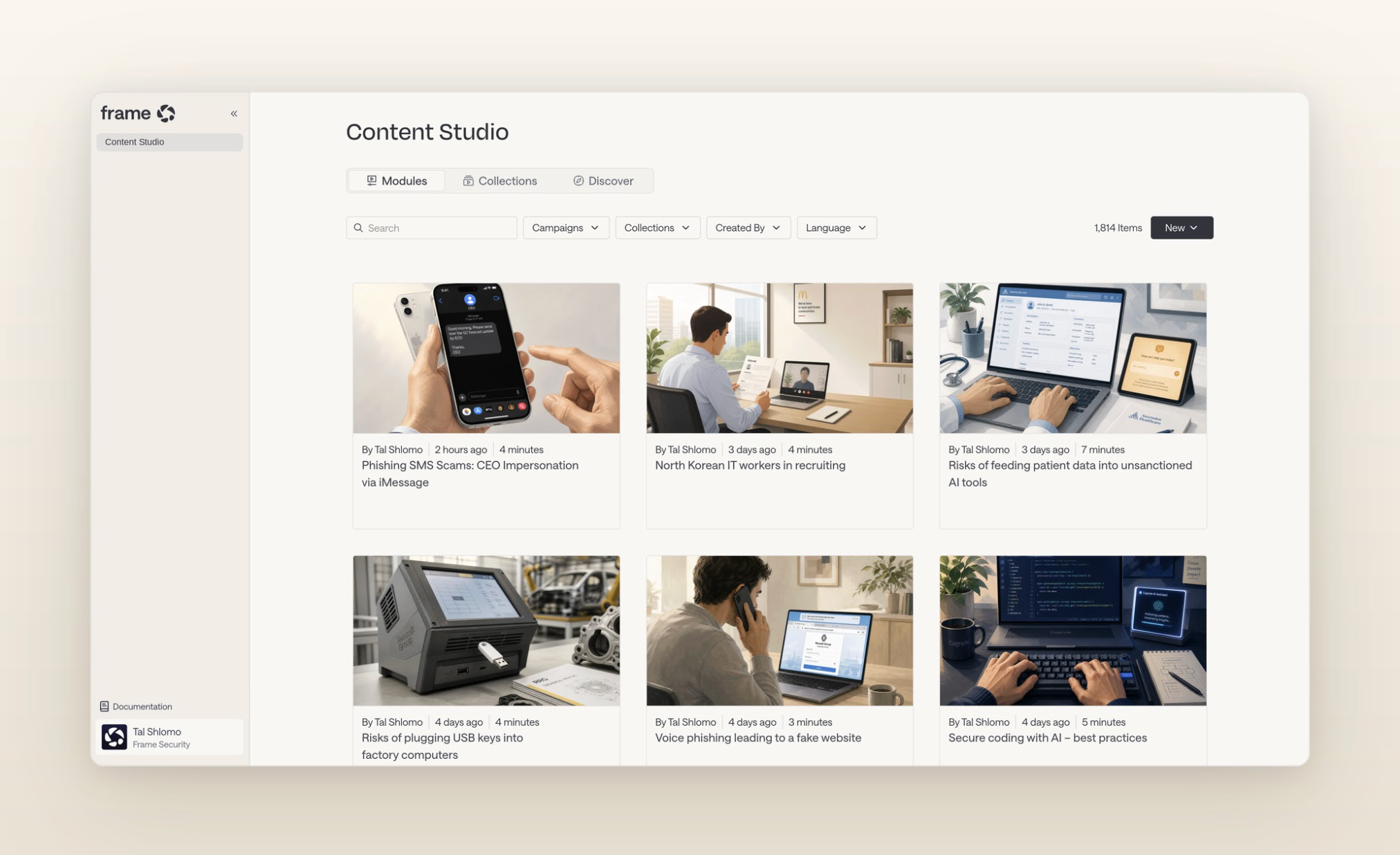
- Create training around the gaps you find. AI Content Studio can generate a training module or simulation from a description in minutes, so you can respond while the issue is still relevant.
- Build on ready-made campaigns. Discover's seasonal campaign collections give you training you can adapt to your organization and deploy when you need it.
- Track risk over time. Results from phishing and deepfake simulations and training feed into each employee's Human Risk Score, which continues to update as new security signals come in.
- Decide where to focus next. Instead of starting again when Cybersecurity Awareness Month ends, use those results to see where risk sits and which employees or teams need more support.
Learn more about Frame's approach to human risk reduction.
Make Cybersecurity Awareness Month count
You only get one Cybersecurity Awareness Month each year. Use the extra focus on security to reinforce good habits, test how employees respond to current threats, and find the areas that need more work.
The goal isn't to have a busy October. It's to know more about your workforce on November 1 than you did on October 1 — and have a plan for what to do next.
See how Frame can help you turn Cybersecurity Awareness Month into an ongoing security awareness program. Book a demo.
Frequently asked questions about Cybersecurity Awareness Month
What cyber threats should Cybersecurity Awareness Month cover?
Cover the cyber threats employees are likely to encounter in their work, including phishing, social engineering, credential theft, and impersonation. Look at recent cyber incidents and the methods threat actors are using against organizations like yours, then use those examples to make training relevant to your workforce.
Can Cybersecurity Awareness Month help prevent cyberattacks?
Cybersecurity Awareness Month gives you an opportunity to strengthen the security behaviors that can help prevent or limit cyberattacks. Training employees to recognize suspicious requests, protect their accounts, and report potential attacks quickly can reduce opportunities for cybercriminals and give security teams more information to act on.
How does employee security awareness help reduce cybercrime?
Many forms of cybercrime rely on getting someone to take an action, such as sharing credentials, approving a payment, or opening a malicious file. Security awareness training helps employees recognize those situations and know what to do next, while simulations let security teams test how people respond in practice.
