
A company opens a new office in Brazil, and three days later, someone in HR asks whether the security awareness training covers LGPD.
A new AI acceptable use policy goes into effect internally, and legal wants employees trained on it by Friday.
A board member reads about a fresh wave of vendor impersonation attacks and asks if the team is prepared.
None of these show up during onboarding. They show up months, or years, into a program, when the library that was carefully built at the start no longer covers what just changed.
With legacy awareness, you file a request, wait for a custom build, or start from scratch. That's the real gap: not what's missing on day one, but what happens the next time something new comes up.
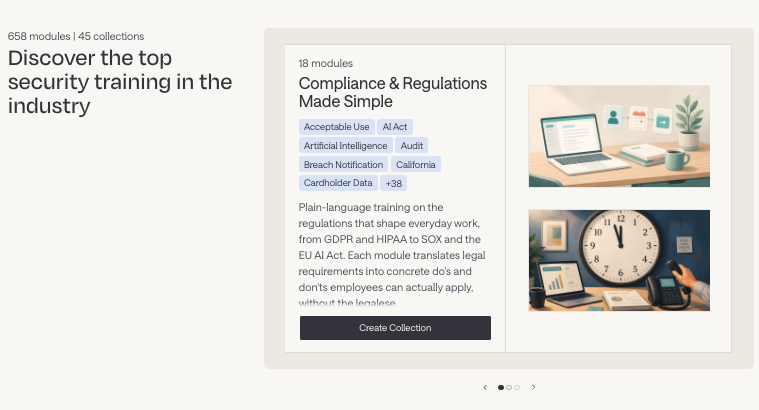
Frame's new Discover tab, inside Content Studio, closes that gap. It's a constantly growing, AI generated library of training collections, organized by compliance framework, threat type, region, and season, that customers can browse and deploy on demand. Frame builds and updates it every week.
Here's what that looks like in practice.
Browse instead of asking
When a new need surfaces, the first move is no longer a support ticket. It's the Discover tab. Type in a topic, a regulation, a region, and see what's already there, GDPR, PIPEDA, LGPD, Swiss privacy law, secure coding, active threat groups, seasonal awareness campaigns. If it's not there yet, it can be queued.
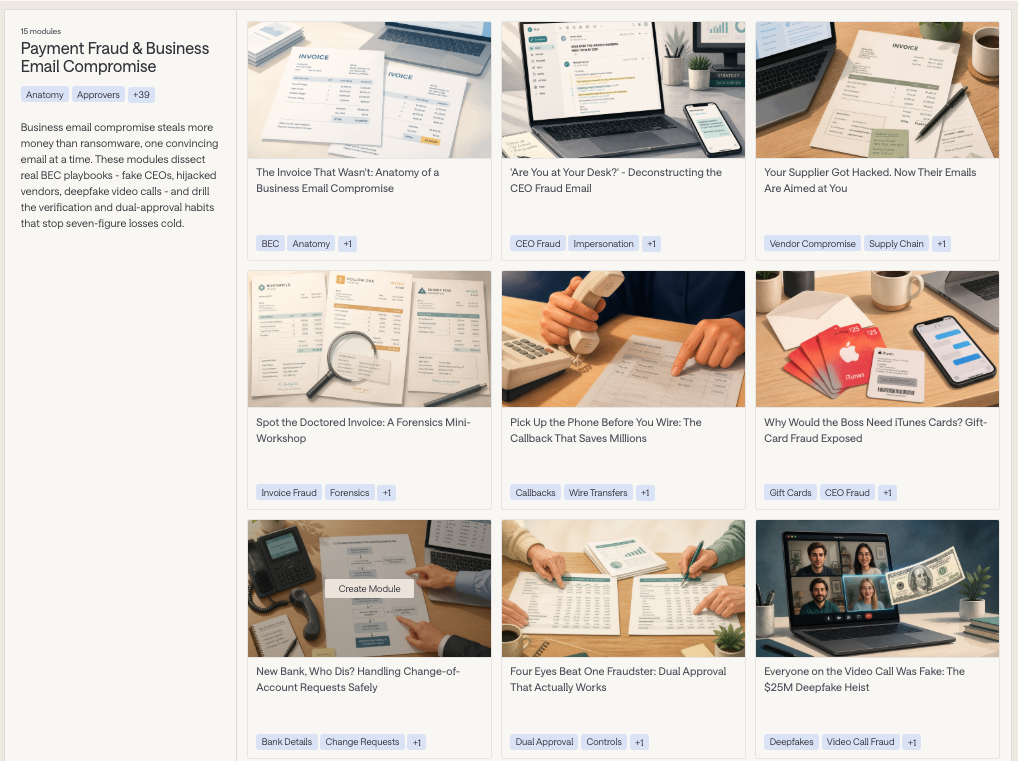
One click, already yours
Deploying a collection isn't a multi step process. Select it, and every module in that collection generates at once, with the company's logo and policy already applied. A collection that would take a legacy vendor's production team weeks or months to build, especially for a region outside their home market, deploys in one click.
Nothing's locked in
None of it is fixed once it's deployed. Language, tone, policy details, all editable after the fact. And if a module gets customized and someone wants the original back, it can be regenerated from Discover at any time.
Legacy security awareness platforms built their libraries the traditional way, a production team scripts and records content, reviews it, and ships it on a schedule. That's why even the largest vendor's library is fixed at any given moment, and why it tends to reflect the market the production team knows best, which is usually the United States. A customer in Brazil or Switzerland or Israel often finds the content technically present but not actually relevant.
Discover works differently because the content isn't filmed, it's generated. That's what makes weekly updates possible instead of quarterly ones, and it's what makes a Brazilian privacy module as available as a U.S. one on day one.
The next unexpected question, whatever it turns out to be, doesn't have to start with a request and a wait. It starts with Discover.
