
If you’re comparing Adaptive Security and KnowBe4, you’ve probably already decided that email-only, completion-driven training doesn’t build a real security culture and no longer matches the social engineering attacks your people face. The remaining question is whether the newer AI-native platforms are proven enough to bet on.
That’s the tension between these two. KnowBe4 is the established leader, with the largest content library in the category and the install base to match. Adaptive Security, founded in 2024, generates multi-channel simulations across email, SMS, voice, and deepfake video. Each is a good answer to a different version of the problem.
This guide compares them on five criteria: channel coverage, how scenarios get generated, what happens after someone fails, what the reporting shows, and what switching involves. It also introduces Frame Security, a third option built on the same AI-native premise.
Note: Every claim about KnowBe4 and Adaptive comes from the vendor’s own current material, checked in September 2026.
KnowBe4: The established standard
KnowBe4 became the default for reasons that still hold. It built the largest content and template library in the category, made simulated phishing something a two-person security team could run without specialist help, and carries compliance coverage broad enough that most auditors have seen its reports before. For a decade, choosing it was the safe decision, and for a lot of programs it still is.
It has also moved fast. AIDA, its set of AI defense agents, now sits on top of the library, and the platform has added simulated vishing (July 2026), smishing, AI-generated callback phishing templates, a deepfake training content agent, and a risk score built from hundreds of behavioral indicators. A comparison against the KnowBe4 three years ago would be wrong on most points.
The ceiling is architectural. KnowBe4 builds content centrally, ships it to every customer, and gates access by subscription tier, so a buyer is paying for the depth of the library. Personalization still works mostly by selecting and routing from that library, with the AI-generated pieces as newer additions.
Reporting has the same lean. There is a risk score now, but the headline metrics are still completion, click rate, and phish-prone percentage, and completion rates measure the wrong thing when a board asks whether risk has moved.
Adaptive Security: The AI-native challenger
Adaptive Security was founded in 2024 and is backed by a16z and OpenAI. Its simulations run across email, SMS, voice, and deepfake video, and they’re generated from public data about each target: the LinkedIn profile, the press mention, the conference talk.
It also offers phish triage for user-reported email, more than 1,000 interactive training resources, and AI governance tooling that flags risky prompts employees enter into AI tools.
Deepfake and voice simulation built from public data is the real draw. Adaptive Security’s governance tooling is a bonus most awareness vendors don’t offer.
Ask how much operating history it has at your scale and whether you can talk to a customer running it at that size. Customer support during a live campaign is worth asking about too. The bigger question is OSINT-driven targeting.
Because simulations are built from public information about named employees, bring in your works council, your data protection officer, or whoever owns GDPR compliance if you’re EU-headquartered, before rollout rather than after.
Adaptive Security vs KnowBe4: the head-to-head
Here are the three platforms side by side on the criteria that separate them. Every KnowBe4 and Adaptive cell comes from that vendor’s own published material, checked in September 2026. Where a vendor claims a capability without detail, the cell records the claim, not how well it works.
Channel coverage is the fastest-moving row in this table. All three vendors have added simulation channels within the last year, so treat it as a snapshot and confirm the current position with any vendor you shortlist. And "AI Content Studio" is the name both Adaptive and Frame use for their content generation, which makes that row easy to misread in either direction.
If reported emails should feed your threat detection and threat intelligence workflows, ask each vendor how its triage connects to the rest of your stack. And ask whether simulations and coaching reach people where they already work, such as Microsoft Teams.
Where the two differ
KnowBe4 is built around breadth: a library deep enough to cover any topic an auditor names, backed by the largest install base in the category. Adaptive is built around realism: simulations generated to resemble the attack a specific employee would actually receive, on the channels attackers now use. Which one fits depends on what is failing in your program.
If the problem is coverage, such as a HIPAA or other compliance obligation across many topics or an auditor who wants evidence in a familiar format, KnowBe4 is the better fit. Its maturity counts as a real advantage there.
If the problem is realism, meaning your people pass every email simulation but nobody knows what happens when AI personas using cloned voices call the help desk, library depth doesn’t help. Adaptive suits teams in that position, as long as they’re comfortable adopting a platform founded in 2024.
Attackers already work these channels. Verizon’s 2026 DBIR found that 41% of social engineering breaches involved vectors beyond email, and the FBI’s IC3 logged 22,364 AI-related complaints in its 2025 report. Neither number picks a vendor for you. Both say a program that tracks only email click rate measures part of the exposure.
Where Frame Security fits
Frame is an AI-native Human Risk Security platform and a KnowBe4 alternative built on the same premise as Adaptive, which narrows the comparison considerably. Both generate rather than select, cover voice and deepfake video, and coach at the point of failure. The difference that matters is where the generated content comes from.
Context source
Adaptive generates from an employee's public footprint. Phishing and deepfake simulations in Frame generate from the organization's own context: org chart, vendor relationships, real communication patterns. The practical difference shows up in the attacks that matter most.
A BEC attempt impersonating a supplier your finance team actually pays, referencing an approval chain that actually exists, isn’t something an OSINT model can construct, because none of that is public. An organization with a low external footprint gets the same quality of simulation as a heavily covered one.
The moment of failure
Real-time coaching arrives immediately when someone falls for a simulation, in more than 70 languages, which matters for the distributed workforces where this is hardest to run.
Reporting
Human risk reduction gives each employee a Human Risk Score built from simulation outcomes, training interactions, MFA posture, and other behavioral signals. Event-based tracking logs risky events as they happen, so the score updates between campaigns. Scores break down by group and department, with built-in action-plan suggestions you can customize.
Training beyond simulation
Security awareness training uses an AI content creator to generate a full module (video, quiz, interactive content) from a description or an uploaded internal policy, in minutes, on any topic.
Both other platforms generate content too. In Frame, simulations and training draw on the same engine and the same facts about your organization, so the training that follows a failed simulation reflects the scenario that triggered it.
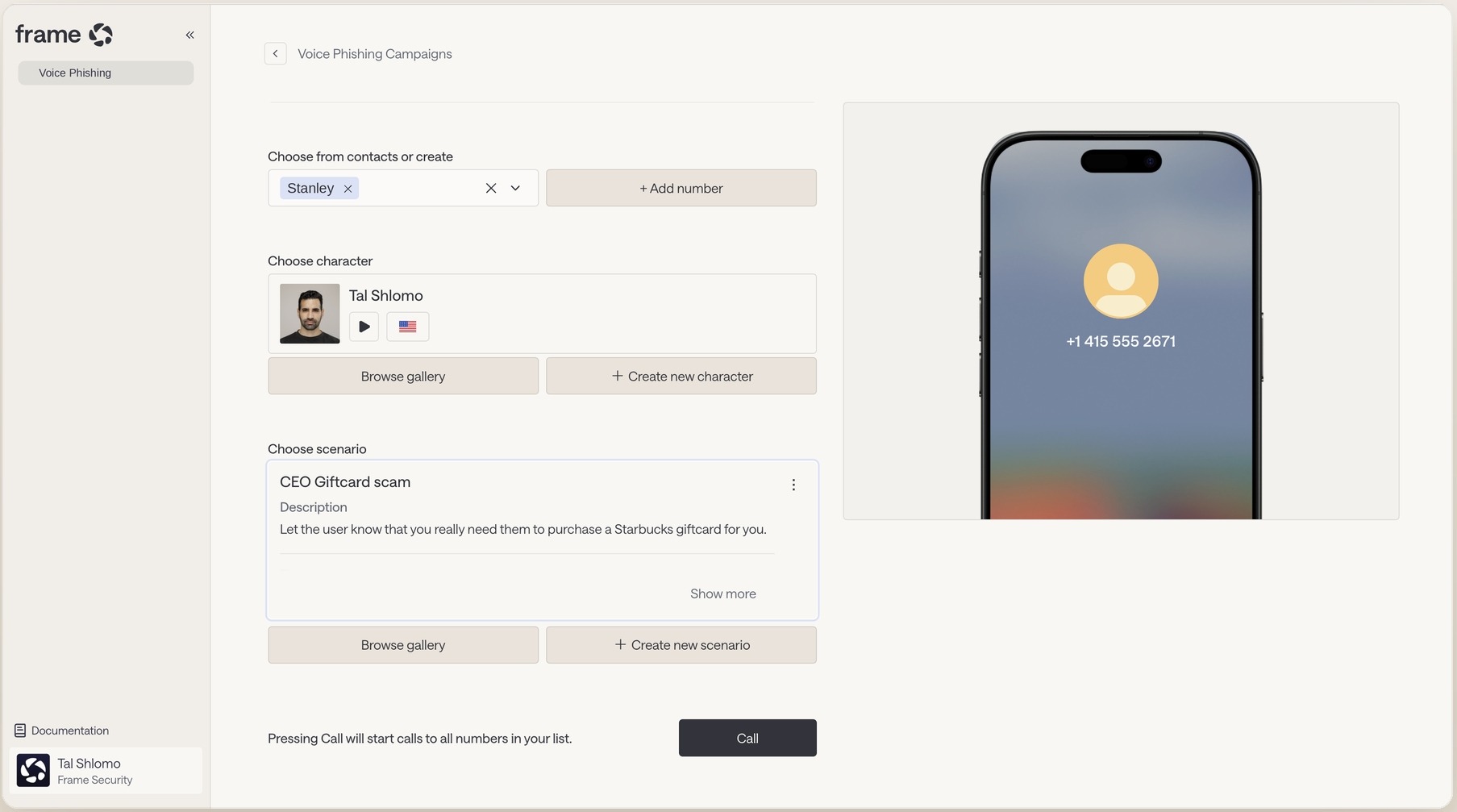
Frame combines the AI-native realism you’d want from Adaptive with the training breadth and program depth you’d expect from KnowBe4. The other two are reasonable choices, and one of them may fit your program better.
How to choose
Five questions will get you most of the way. Answer them about your own program, then see which platform fits.
- Is your main problem coverage or realism? If it’s compliance training breadth across many topics, KnowBe4 fits. If it’s resistance to modern attacks and AI threats, you’re looking at Adaptive or Frame.
- Do you need training depth as well as simulation? KnowBe4 has the largest ready-made library. Adaptive and Frame generate content on demand, and Frame’s content comes from the same engine and organizational context as its simulations. If the program covers secure coding, a new AI acceptable-use policy, and regional compliance, ask each vendor how fast they can produce a module outside their core simulations.
- How much does maturity matter? KnowBe4 wins on track record. Adaptive and Frame were both founded in 2024, so ask for a reference at your scale before anything else.
- Where should personalization come from? Adaptive builds from public footprint, Frame from internal context, and KnowBe4 mostly routes from its library by role and behavior. The OSINT approach is worth raising with your DPO early.
- What does your board need to see? If the answer is movement in risk over time instead of completion percentages, ask each vendor what its number is built from. Questions to ask before renewing covers the rest of that conversation, and alternatives to KnowBe4 covers the wider field if you’re still scoping.
All three beat email-only annual training. The two AI-native platforms address modern multi-channel attacks in a way KnowBe4’s library model was not built for, and choosing between them comes down to where the context comes from and whether training breadth matters alongside simulation.
Book a demo and ask Frame to build a simulation from your own org chart, so you can see what internal context changes.
