
What counts as compliance training varies from team to team. For HR, it might mean harassment prevention, workplace safety, ethics, and other mandatory training, while security and GRC mean the training required by frameworks such as ISO 27001, SOC 2, HIPAA, and PCI DSS, along with the records to prove it happened.
That difference produces very different shortlists for compliance training software. Organizations buy a platform for one set of compliance requirements, then discover months later that it doesn't satisfy the other, usually when an auditor asks for evidence the platform can't produce.
This guide breaks down what compliance training software actually covers, how to work out which problem you’re solving, and what to verify before choosing a platform.
What compliance training software does
Compliance training software is a platform that assigns, delivers, tracks, and documents the training an organization is required to complete for regulatory, legal, or contractual reasons. The documentation half is what distinguishes it from training software generally.
The real value comes from what happens after assignment.
- Reminders chase people who haven’t finished.
- Completion tracking records who completed what and when.
- Version history shows which iteration of a policy someone acknowledged.
- Training or certification expiry triggers recertification when it’s due.
- Compliance reporting turns those records into an audit trail that holds up when an auditor, regulator, or customer asks for evidence.
That’s what separates compliance training software from an ordinary learning management system: it isn’t just delivering employee training. It’s creating evidence that compliance requirements were met.
The subject areas are broad enough that most organizations have several compliance training programs running at once:
- Workplace safety, including OSHA-regulated topics
- Harassment prevention and code of conduct
- Data privacy under GDPR, HIPAA, and state privacy law
- Cybersecurity awareness and phishing
- Anti-bribery and corruption, including FCPA
- Financial services regulation and anti-money laundering
- Sector-specific rules in healthcare, construction, and manufacturing
Compliance training software covers two different needs
Compliance training software can provide the system that delivers and tracks training, the training content itself, or both. Many organizations need both capabilities but discover too late that the platform they chose only solves one.
Training delivery and compliance tracking
This is the operational layer:
- Assignments
- Reminders
- Completion tracking
- Recertification schedules
- Audit trails
- Compliance reporting
Many organizations already use a general learning management system (LMS) for this, configured to manage mandatory training alongside other learning programs.
Where a general LMS can start to strain is at the evidence layer. LMS platforms typically tell you who completed what and when. Compliance management needs to answer a different question: which compliance requirement does that training satisfy, and can you prove it? Without that capability, teams can end up maintaining the mapping manually in a spreadsheet.
Compliance training content
This is what employees actually complete: modules, videos, quizzes, assessments, and microlearning covering the relevant policies, risks, and industry regulations. Organizations typically source this content in three ways:
- An off-the-shelf library: Fast to deploy and maintained by the vendor, but written to serve a broad audience. Updates also follow the vendor’s release cycle rather than your own.
- An authoring tool: Content can match your policies and terminology, but your team has to create and maintain it whenever regulations, risks, or internal policies change.
- Generated from your own material: The platform turns your policies and organizational context into training content, reducing the work involved in creating and updating it when requirements change.
Before comparing compliance training platforms, work out which capability you’re actually missing:
- Need to assign training, track completion, manage recertification, and produce compliance records? Look for a delivery and tracking system.
- Need relevant training that reflects your policies, roles, and compliance requirements? Look for a strong content library, authoring tools, or policy-generated content.
- Need both? Look for a platform that connects training content directly to the records and controls it satisfies.
HR and security compliance training need different capabilities
HR and security teams may both need compliance training software, but they’re solving different problems.
- HR typically needs to deliver required training and prove employees completed it.
- Security and GRC teams also need to show that training addresses specific controls, policies, systems, and roles.
That difference matters when you compare platforms.
A strong HR compliance platform may cover harassment prevention, workplace safety, and code of conduct but offer only generic cybersecurity awareness training. That becomes a problem when security teams need training to reflect the systems employees use, the policies they follow, or the risks associated with their roles.
The evidence can be different too.
Completion tracking may be enough to show that mandatory HR training happened, but security and privacy frameworks can require more detail. Teams may need to show which training supports a particular control, who received role-specific training, which version they completed, and when recertification is due.
Start with the requirement driving the training.
If it comes from employment law or an HR mandate, evaluate the platform against that requirement. If it comes from ISO 27001, SOC 2, HIPAA, GDPR, PCI DSS, NIST, or another security or privacy framework, evaluate what the framework requires and what evidence you’ll need to produce.
6 questions to ask before choosing compliance training software
Before choosing compliance training software, ask vendors these six questions.
Don’t just check whether a feature exists. Ask to see how it works, what evidence it produces, and how much manual work your team will still have to do.
- Which frameworks does the training map to?
Ask to see how training maps to the specific frameworks and controls you need to satisfy. Then ask what happens at audit time: can you produce evidence against those controls directly, or does someone have to rebuild the mapping manually? What your auditor actually wants is evidence organized by control rather than assembled from screenshots and spreadsheets. - Can the content reflect our policies, systems, and terminology?
Ask the vendor to show you how far customization actually goes. Changing a logo or company name isn’t the same as training employees on the policies, tools, processes, and compliance requirements they work with. - Can training be tailored by role?
Check whether different roles can receive different training and whether the platform records who received which version. For security and privacy compliance, you may need to evidence role-based training rather than just show that everyone completed the same course.
- How quickly can training be updated?
Policies, regulations, systems, and risks change. Ask what happens when yours does: who updates the content, how much work is involved, and how long it takes to get revised training in front of employees. - What compliance records can we export?
Ask to see the actual output. Check whether completion records, training versions, dates, role assignments, and control mappings can leave the platform in a format your auditors, insurers, customers, or GRC tools can use. - How does training reach employees?
If you already have an LMS, find out whether the platform integrates with it or supports SCORM export. If it uses its own app, check what that adds to the employee experience and whether it creates another system your team has to manage.
What compliance frameworks require from employee training
Security and privacy frameworks don’t just require organizations to provide employee training. Depending on the framework, they can also set expectations for who receives it, when it happens, what it covers, and what records you keep.
That means one annual compliance training module isn’t enough to satisfy every requirement.
The important differences are frequency, relevance, and evidence.
- NIST separates role-based training into its own control, requiring training based on assigned security and privacy responsibilities.
- ISO 27001 Annex A 6.3 also expects awareness, education, and training to be relevant to job function.
A single course assigned to every employee may therefore leave gaps where more specific training is required.
Frequency varies too.
- PCI DSS requires security awareness training when personnel are hired and at least once every 12 months, alongside an ongoing security awareness program.
- HIPAA requires a security awareness and training program for the workforce and includes periodic security updates.
Those requirements make it important to check whether a compliance training platform can support recurring training, role-based assignments, recertification, and shorter interventions such as microlearning rather than relying on one annual course.
What to look for in security and privacy compliance training
If you're buying compliance training software to meet a security or privacy framework, look for capabilities that connect training to the requirements you need to meet and the evidence you need to produce. That connection matters most at audit time, when the question stops being who finished and becomes which control each session satisfies.
Frame Security focuses on the security and privacy side of compliance training. It generates training from your own policies and context, maps coverage to frameworks including SOC 2, ISO 27001, HIPAA, GDPR, PCI DSS, and NIST, and builds the supporting evidence as training runs.
That includes:
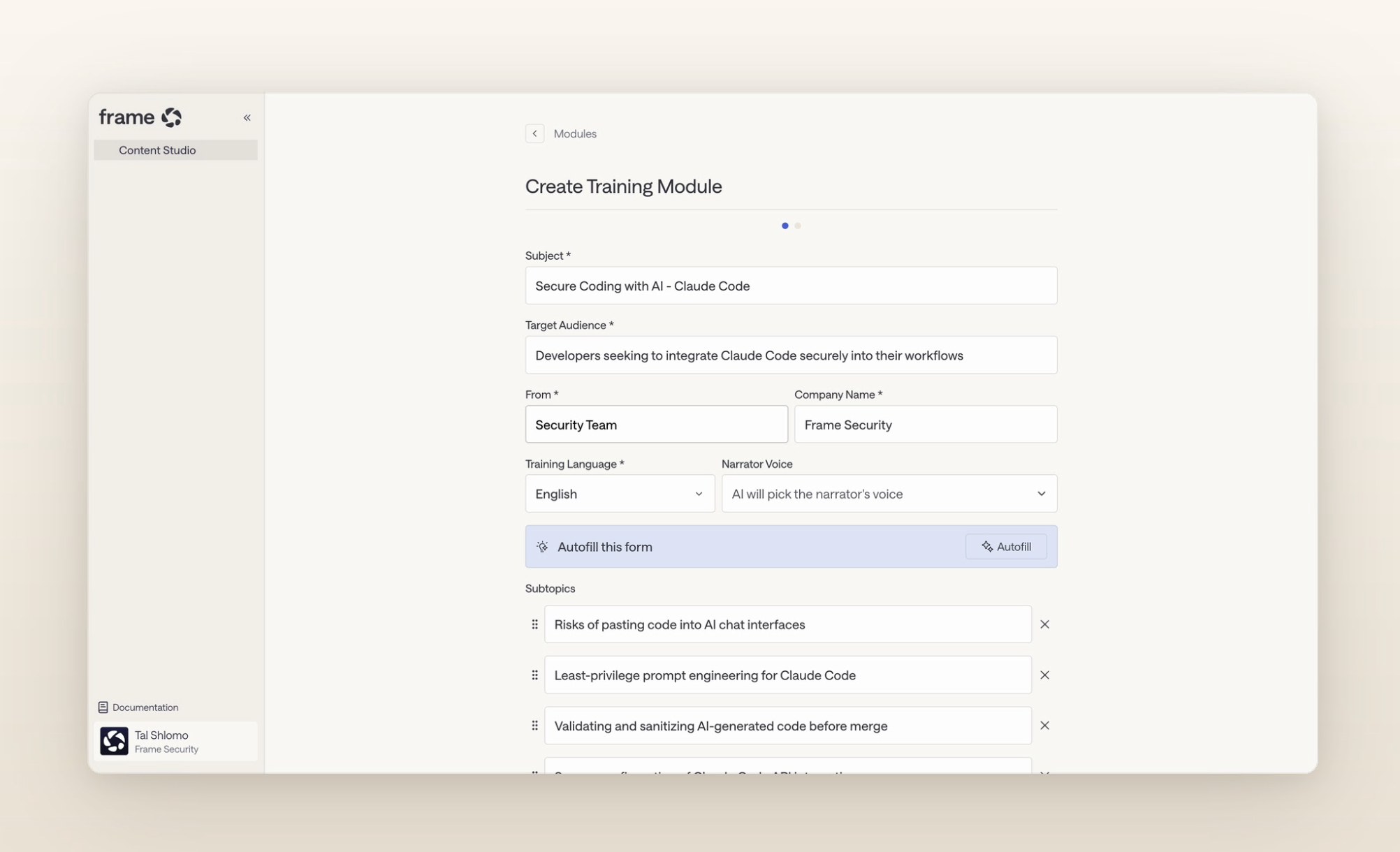
- Training based on your policies: Generate security, privacy, and compliance training from your own policies, systems, and terminology instead of relying on a fixed content library.
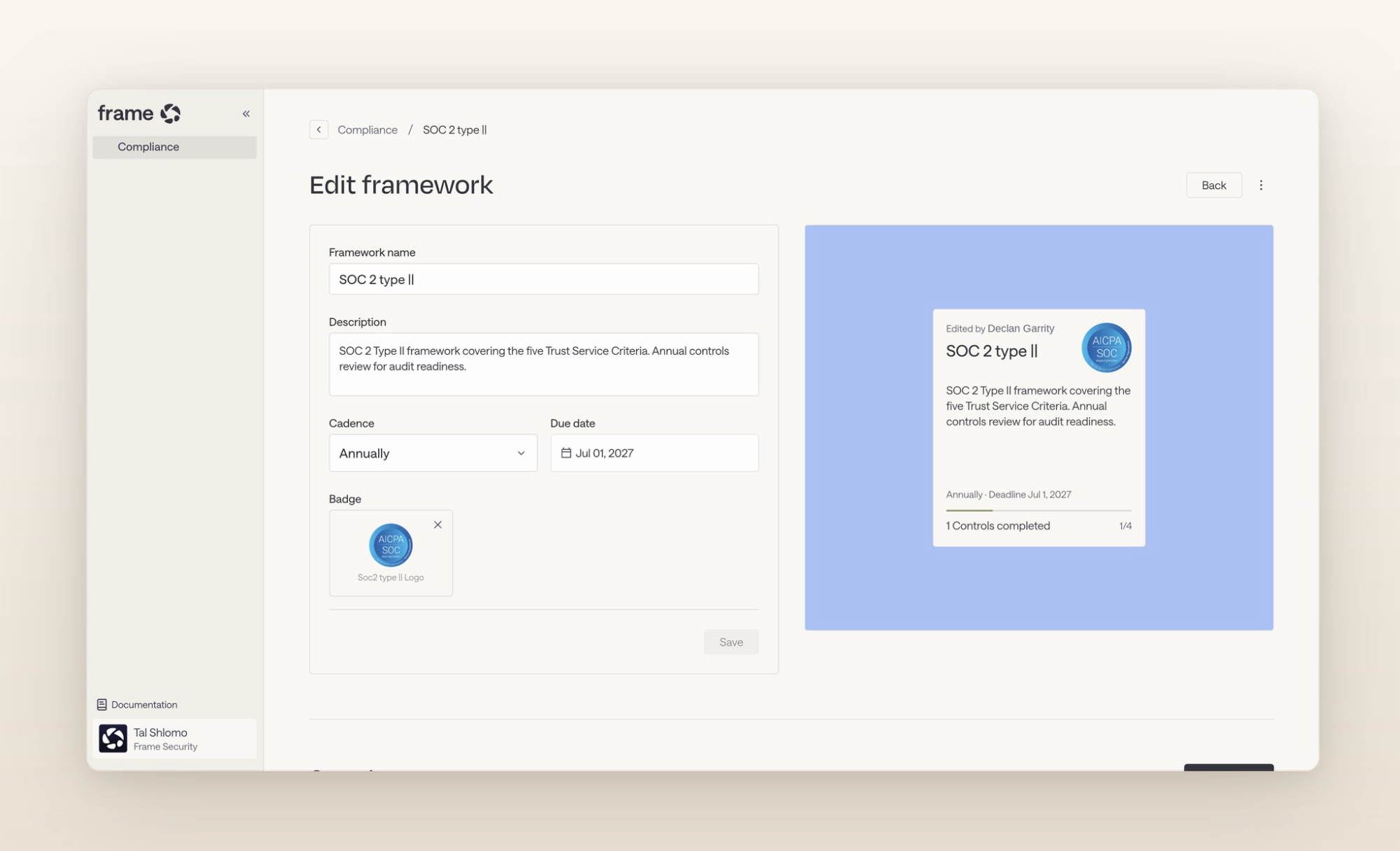
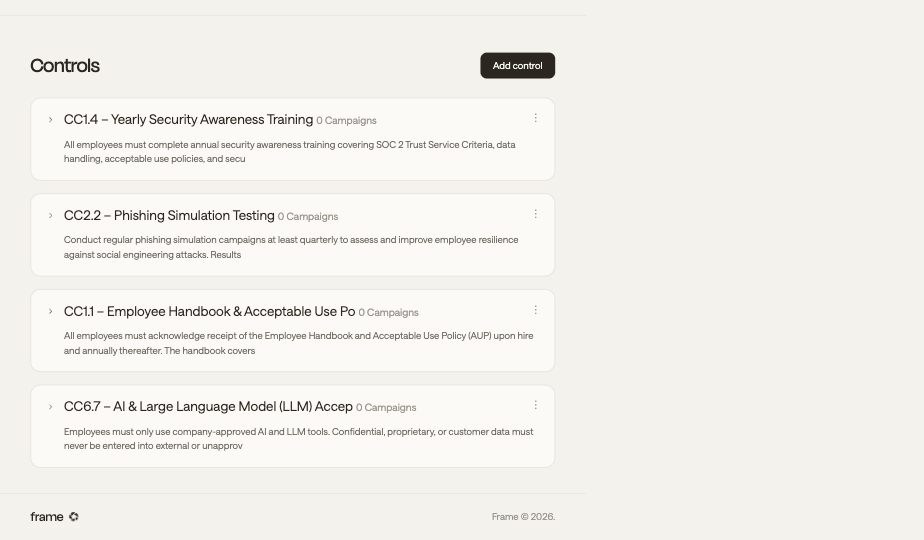
- Framework-mapped training: Connect training campaigns and simulations to specific framework controls, so you can see what each activity helps you satisfy.
- Role-based content: Give employees training that reflects their responsibilities, from secure coding for engineers to data privacy requirements for teams handling personal information.
- Flexible delivery: Run training in Frame or export it as a SCORM package to your existing learning management system. Frame’s integrations also keep employee and organizational data up to date for role-based assignments.
- Audit-ready reporting: Build compliance records as the program runs, with audit-ready reports that show the training and evidence connected to each requirement.
- Training that’s easy to update: Edit generated content or rebuild it when a policy, regulation, or internal process changes, rather than waiting for a standard content library to be updated.
- Employee-level risk measurement: Combine training engagement, simulation results, and other behavior signals into a Human Risk Score. This adds context that completion tracking alone can’t provide. Read more about why completion rates measure the wrong thing and human risk reduction.
The right compliance training platform depends on what you need to prove. For security and privacy compliance, that means looking beyond whether employees completed a course to whether the training matches your requirements and produces evidence you can use.
To see how Frame combines framework-mapped compliance with security awareness training built from your own policies, book a demo.
Frequently asked questions about compliance training software
What’s the difference between an LMS and compliance training software?
An LMS manages learning programs across an organization. Compliance training software adds capabilities such as mandatory training, recertification, completion tracking, compliance reporting, and audit trails designed to help prove specific requirements were met.
Can compliance training software integrate with an existing LMS?
Yes. Some platforms integrate with LMS platforms or export SCORM packages, allowing organizations to keep employee training in one place while adding specialist compliance capabilities.
How often should compliance training be updated?
It depends on the requirement. Update training when regulations, policies, systems, roles, or risks change, as well as at any frequency required by the relevant framework.
