
Audit season arrives, and the routine starts. Someone on the security team downloads a CSV from the training platform. Someone else takes a screenshot of a completed phishing campaign. Both get emailed to the GRC team, who forwards them to the auditor, who may or may not ask for the same thing in a slightly different format next quarter.
Nobody designed this process on purpose. It's just what happens when the platform that runs the training and the platform that manages compliance were never built to talk to each other.
Compliance isn't a policy problem, it's an evidence logistics problem
Every security awareness vendor says they help with compliance. In practice, that usually means a PDF completion report, proof that training happened, sitting in a folder. It doesn't say which SOC 2 control that training satisfies. It doesn't map to what an auditor is actually asking for. And it definitely doesn't talk to whatever GRC tool, Vanta, Drata, Anecdotes, is supposed to hold that evidence.
So the mapping happens by hand. Someone has to know that this campaign satisfies that control, remember it twice a year, and manually move the evidence from one system to another. That's not a compliance program, it's institutional memory standing in for infrastructure.
Build the framework, not just the training
Frame's Insights suite includes a Compliance Dashboard: a place to build a framework, SOC 2, ISO 27001, or something fully custom, name its controls, and attach the training campaigns and phishing simulations that fulfill each one.
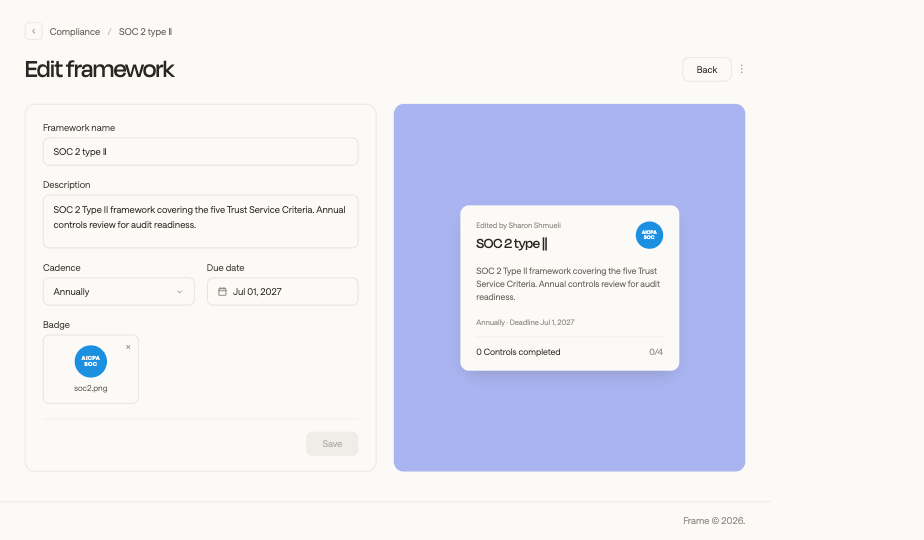
Once a framework exists, controls sit underneath it, each one able to hold whatever evidence actually proves it's satisfied.
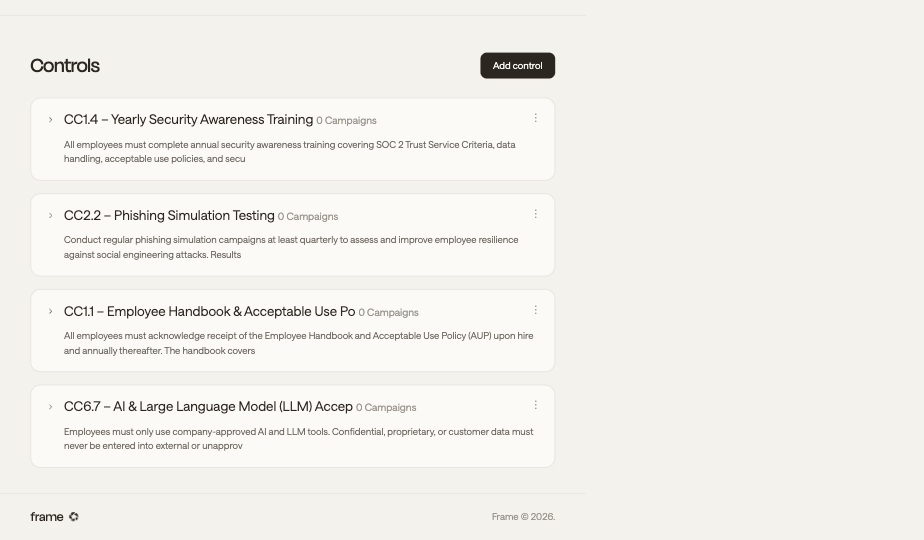
Nothing here needs to be built in a particular order. Controls can exist before a single campaign is attached, and campaigns get linked as they're created. When it's time to produce evidence, none of it needs to be found first. It's already organized by the framework and control an auditor asked about, and it exports automatically, via API, to whatever GRC platform the evidence needs to live in.
The control nobody had a template for
Auditors are increasingly asking organizations to document that employees were trained on safe use of AI tools, and a generic vendor module doesn't hold up once the question gets specific. If a company has standardized on a particular tool, ChatGPT, Gemini, an internal model, the training needs to name that tool, not gesture vaguely at "AI safety."
A static content library can't do that. Frame lets a team build that training themselves, in their own Content Studio, and attach it directly to the control. The evidence an auditor sees isn't a generic module licensed from a vendor. It's documentation that the organization trained its own employees on the specific tools they actually use.
The evidence is already where it needs to be
Go back to the download-screenshot-email cycle from the opening. With the Compliance Dashboard, that cycle doesn't happen. The evidence lives in one place, organized by framework and control, and it reaches Vanta, Drata, or Anecdotes automatically, without anyone remembering to move it.
The next time an auditor asks for evidence, nobody has to go looking for it. It's already been pushed to exactly where it needs to be.
Schedule a demo to see Frame in action.
