
Every CISO and cybersecurity leader has been told to build a security culture. Very few could say what that looks like on an ordinary Tuesday afternoon: which behavior would be different, who would do it, how anyone would notice. The phrase appears in every board deck, but the definition appears nowhere.
The stakes are straightforward enough without reaching for statistics. Technology filters out many cyber threats, and what gets through reaches a person who has to decide something. Culture is the word for whether those decisions default to caution or to getting the task done.
This guide defines the term in observable terms, walks through the stages a culture moves through, and gives the levers that actually move it. It’s the entry point to a set of deeper guides rather than a replacement for them.
What is security culture?
Security culture is the shared attitudes, habits, and unwritten norms that shape how people in an organization behave toward security, especially when nobody is watching and no policy is in front of them. It's what's left after the training ends, and the poster comes down.
The distinction the rest of this piece depends on is a three-step one:
- Awareness: knowing that phishing and social engineering exist.
- Training: having practiced the response, for example through phishing simulations.
- Culture: whether reporting a suspicious message is the normal, expected thing to do, or the thing that makes you look paranoid in front of your team.
Awareness and training are inputs. Culture is the outcome they should produce and often don't. It's hard to define because it's collective and mostly invisible. It shows up in what people do when no one is observing, so most organizations can't tell whether they have one. The ones that feel sure they do are often measuring something else, like completion rates.
Why security culture matters more than awareness alone
An aware workforce that doesn't act isn't a secure one, and awareness training routinely produces the first without the second. Program owners feel this gap most: every input metric looks healthy while the outcome stays flat.
The reason is human factors, meaning how people behave under pressure. Someone can ace a phishing quiz in March and still click a convincing invoice in July. At 4:50 p.m. on a Friday, the question in their head is "what do I need to finish," not "what did the module say." Habit and social norm decide that moment, and recalled knowledge rarely gets a vote.
Culture is what fills that gap, and incident reporting is where it shows most clearly. Whether people report quickly and without fear is a reliable marker of a strong security culture. Reporting turns one person's human error into the organization's detection.
An employee who clicks and reports within a minute gives your team a live incident with time to act. One who clicks and stays quiet gives an attacker a head start that can end in data breaches. A completion report can't tell them apart, which is why completion rates measure the wrong thing.
The stages of security culture maturity
A maturity model makes an abstract thing trackable by converting "do we have a culture" into "which stage are we at and what does the next one require." Several exist, and they broadly agree on the shape; the vendor-neutral reference point is the SANS Security Awareness and Culture Maturity Model, which describes five.
1. No program
Information security is nobody's job outside IT. Behavior is whatever each person happened to arrive with, which means the organization's exposure to security breaches is a function of its hiring history rather than anything it’s decided.
2. Compliance-focused
Training exists to satisfy an auditor. The goal is completion, the metric is a percentage, and the program exists to produce evidence rather than change. This stage is stable and comfortable, which is part of the problem.
3. Promoting awareness and behavior change
The program actively tries to change what people do, including risky behaviors, rather than only what they know. Simulations test behavior, content targets specific risks, and someone is looking at the results with an intention to act on them.
4. Long-term sustainment and culture change
Secure behavior is becoming the social norm. Reinforcement comes from peers and managers rather than from the security team's mandate, and new joiners absorb the security-conscious norm from the people around them rather than from onboarding slides.
5. Optimization and resilience
Security is embedded in how the organization operates, measured against business outcomes, and largely self-sustaining. SANS is direct that programs reach this by advancing one stage at a time, and that jumping from compliance-focused to optimization is neither practical nor sustainable.
The honest observation about this ladder: Many organizations sit at stage two while believing they're at stage four, because completion rates are high and nothing has gone visibly wrong. High completion is exactly what stage two produces.
How to build a security culture
Five levers, each a concrete action rather than an aspiration. They run roughly in order of how much culture they move per unit of effort, and the first costs nothing at all.
1. Make leadership model it, not just fund it
Culture follows what senior people visibly do, and a budget line is invisible. When a CEO tells the company they fell for a phishing test, it shows that failing is survivable and that saying so is normal. A policy memo can't do that.
The version that costs nothing: have an executive report a suspicious message through the same channel everyone else uses, and mention it.
2. Replace punishment with reporting
A blame culture suppresses reporting, the behavior that gives your team time to act. Name individuals for failing a simulation and reporting collapses within weeks, because the rational move becomes deleting the message quietly.
Measure and publish report rate rather than click rate, and keep failure data aggregated and out of manager conversations unless there’s a genuine pattern.
What you’re building is psychological safety in a narrow, practical sense: the confidence that telling the security team something went wrong won’t cost you anything. Coaching at the moment of failure sets that tone, because everyone who fails a simulation sees that landing page.
3. Make security relevant to each role
Generic messaging reads as noise and gets filed accordingly. People adopt habits that map to threats they can imagine facing, which means a finance team needs training on invoice fraud and an engineering team needs secure coding that closes vulnerabilities, not the same quarterly module about password length.
4. Reinforce continuously, because culture decays
A single campaign fades, and the decay is measurable. A 2023 scoping review in Computers & Security found that training effects lasted six months at most, with brief refresher material stretching them to twelve. An annual event therefore spends most of the year outside the window where it works. How quickly behavior decays without reinforcement covers the shape of that curve.
Short, frequent reinforcement beats long, rare cybersecurity training. Microlearning, nudges, and light gamification all serve this, provided the cadence is steady rather than seasonal.
5. Recruit champions across teams
Norms spread through peers faster than through the security team, and a named advocate in each department translates general security best practices into the local dialect. A champion who tells their own team what a suspicious message looked like in their own inbox is doing something security awareness training delivered centrally can’t.
How to measure security culture
The thing that stops most culture efforts is the belief that culture resists measurement. It doesn't, provided you measure behavior rather than opinion.
What to track:
- Report rate and time to report: two direct behavioral signals that tend to move early when culture improves.
- Repeat-failure concentration: whether cyber risk clusters in a small group or spreads evenly, which tells you whether you have an individual problem or a norm problem.
- Unmandated participation: attendance at optional sessions, questions asked, champions volunteering. Voluntary engagement is a culture signal in a way that mandatory completion never is.
- Movement by department over time: culture is local. An org-wide average conceals the team where the norm is genuinely strong and the one where it’s never taken hold.
Attitude surveys have a place, and it’s a supporting one. What people say about security in a survey and what they do at 4:50 p.m. on a Friday diverge reliably enough that a survey should never stand alone.
Turning culture from a slogan into a number
Culture is real; it decides outcomes, and it's hard to see. Nobody can manage, fund, or defend something they can't see, so the job is to make it observable.
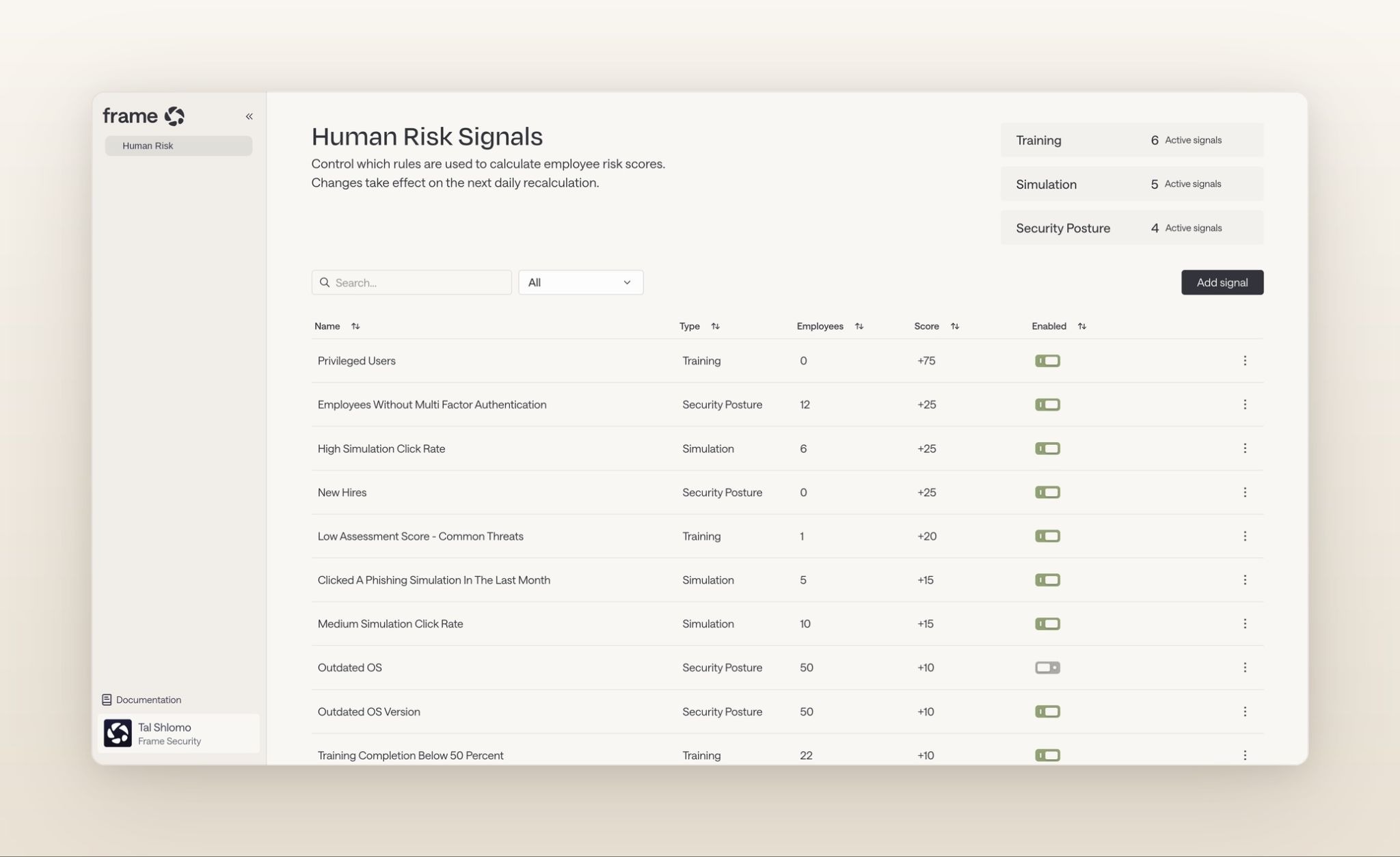
Frame Security is an AI-native Human Risk Security platform built to do that through human risk management. Human risk reduction combines what your people actually do into a Human Risk Score for each employee: simulation outcomes, reporting behavior, training engagement, MFA posture, and other behavioral signals.
The score moves over time and breaks down by department, so culture shows up as a trend you can read team by team, alongside your wider security posture.
Behavior feeds the score, including risky actions like clicking a simulated phishing link. Phishing and deepfake simulations across email, voice, and video test real behavior, and real-time coaching reaches people the moment they fail, which is where a norm actually shifts.
"Build a security culture" stops being a slogan once you can watch the number move. Book a demo and see what your culture looks like as a trend line.
