
October is National Cybersecurity Awareness Month, the one month of the year when security has the attention of the entire company. It is also the month most likely to be spent on posters, a themed Slack channel, a lunch and learn, and a quiz with a gift card attached.
While these activities generate engagement, they don’t generate data. By the time November arrives, you know nothing you didn't know in September. October ends up being little more than an expensive way to end up where you started.
Every idea below leaves behind a measurement that still means something in six months.
What to confirm before you plan October 2026
Two details are worth settling before anyone writes poster copy. Both take about ten minutes to check, and the first is wrong on a surprising number of vendor pages, which is how identical errors end up on posters at a dozen companies.
The campaign has two official themes
The National Cybersecurity Alliance (NCA) and the Cybersecurity and Infrastructure Security Agency (CISA) co-lead the campaign, and each publishes its own theme.
The National Cybersecurity Alliance theme is "Don't Make It Easy for Them," centers on four behaviors that help people stay safe online: strong passwords or passphrases and a password manager, turning on multi-factor authentication, recognizing and reporting scams, and updating software when security updates are released.
CISA's theme is "Securing the Next 250," connects to the country's 250th anniversary and targets critical infrastructure operators defending against cyber threats; its toolkit carries the supporting material. Most vendor pages cite one theme as though it were the only one, and several cite it wrongly or blend the two into a phrase neither organization uses.
Check both against the source sites before committing to print. For a general office population, the Alliance’s online safety framing usually travels better; critical infrastructure and public sector teams get more from CISA's.
The month is longer than it feels
October 1, 2026 falls on a Thursday, and the month closes on Saturday, October 31, which leaves 22 working days. That’s enough for four distinct weekly pushes with room to spare.
One sequencing decision shapes everything else: pick the measurement before you pick the activities. An activity chosen for engagement and an activity chosen for signal look identical on a calendar and produce completely different Novembers.
Ideas that establish a baseline worth keeping all year
The three ideas below run in a fixed order for that reason: take the baseline first, then make the calendar visible, then get a business leader to explain what the month is for.
Run an unannounced multi-channel phishing simulation in week one
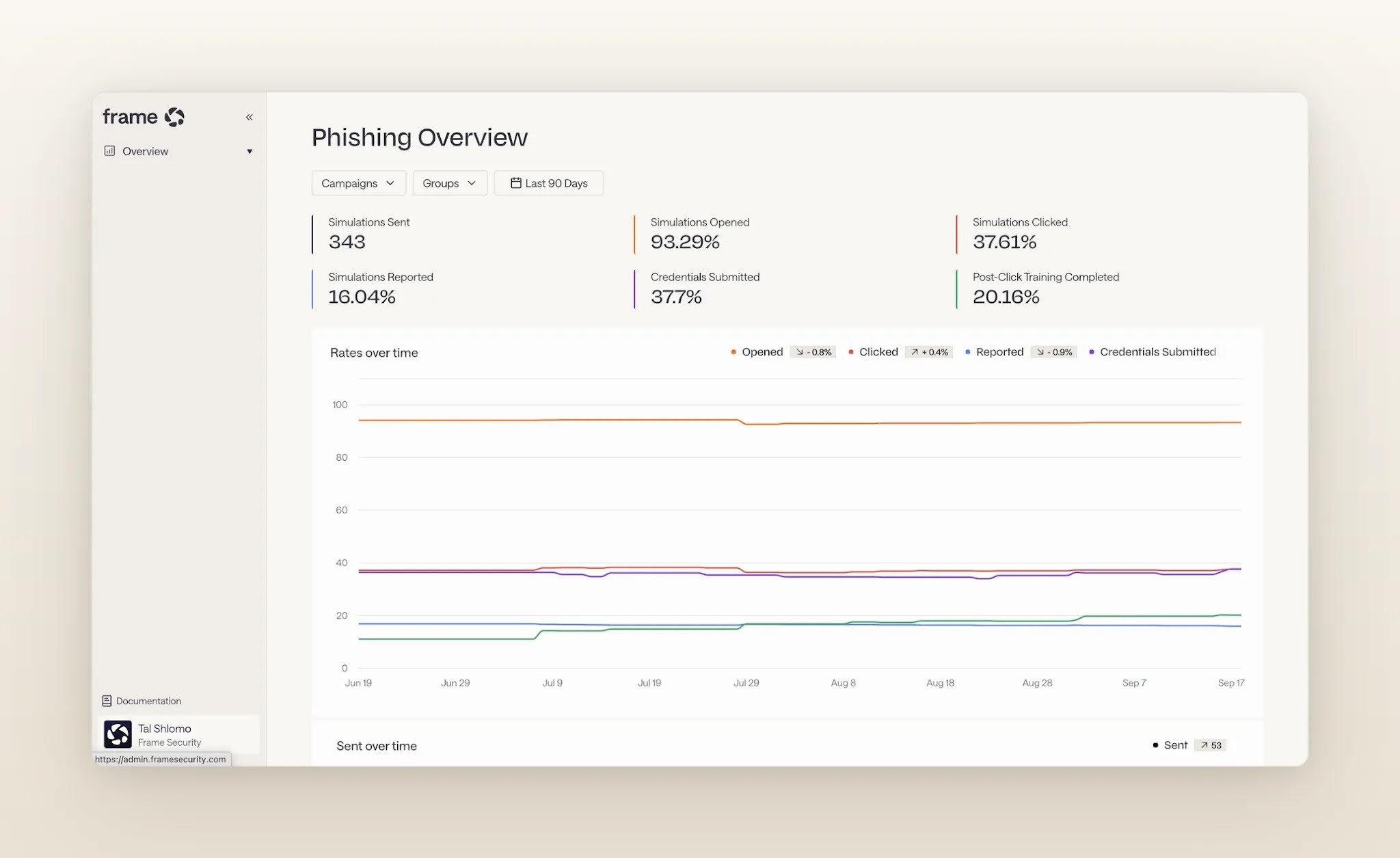
You'll measure everything else in October against this simulation, so the timing matters more than any other detail. Once a poster goes up or a training module lands, people behave differently, and you can't get the untouched number back.
Capture click rate, report rate, and time to first report, each split by department. The split matters most, since an org-wide average blends a team that reports in minutes with one that never does. Send it by email and at least one other channel, staggered across the day, and warn the help desk so the drill doesn't trigger a real escalation.
Publish the campaign calendar on day two
With the baseline already captured, the rest of the month can be fully visible without contaminating anything. People plan around what they can see, and a published schedule stops October feeling like a series of ambushes from the security team. It is also the natural place to list the cybersecurity best practices each week will reinforce.
This also buys you honesty in reporting. A simulation run against a population that knew a campaign was happening produces a different number than one run cold, and publishing the calendar makes that distinction clean rather than something you have to caveat later.
Open with a kickoff from a business leader
Employees read a message from the COO differently than one from security, and managers take the month more seriously when it comes from the business. Ask your leader to cover what October is, what you'll measure, and one promise: nobody gets named or penalized for failing a simulation.
That promise matters most. People report messages they're unsure about only when reporting feels safe, and without it your report rate will undercount what employees actually noticed.
Ideas that test the channels your program usually skips
Your program probably tests email and stops there. Attackers move on to the channels your program has never measured, so the gaps in your data sit where they spend their time. The three ideas below go after those gaps.
Run a voice phishing drill against the help desk
Reset-request social engineering is the attack most programs never simulate, and it has a short path to domain access. An attacker who talks a help desk agent into an MFA reset never has to phish anyone, because the agent hands over the access. That access can lead straight to account takeovers and data breaches.
Call in with a plausible story and a deadline, and watch what the agent does. Some will verify your identity through an independent channel before acting. Fewer will keep doing it once you sound rushed and the manufactured urgency builds. A pass is a verification attempt, whatever the outcome of the call.
Stage a deepfake video or cloned-audio approval request
This activity can change a senior stakeholder's mind about your program’s budget. Executives are the targets of these cyberattacks, so when the demonstration reaches them, they see the risk for themselves instead of reading about it.
Send an approval request in a cloned executive's voice or video and see who acts on it. Build the scenario from a real incident. The human threats landing on trained workforces in 2026 walks through the ones worth modeling.
Test QR codes in a physical space
Put printed codes where people wait: the break room, the lift lobby, the parking area. Each one should point to a landing page that teaches, with no scoring language anywhere on it. You're counting how many people scan, so coverage is the goal and a pass rate has no place here.
Email never reaches warehouse staff, drivers, clinical teams, or anyone else who works away from a desk, and most awareness programs miss them entirely. A printed code reaches them where email doesn't.
Ideas that build reporting behavior
A simulation tells you who clicked, but it says much less about who noticed something odd and told someone. That second group is the one your security team can act on while an attack is still underway. The three ideas below are built around them.
Make report rate the number you publish
Whichever number you put in front of the company becomes the behavior you get. Celebrate low clicks and people learn that ignoring suspicious emails is the safe move. Celebrate fast reports and they learn to send it to you.
A report gives your team something to act on, and an ignored message gives it nothing. Publish report rate in your weekly updates and keep click rate for your own analysis.
Run a department leaderboard on time to report
Rank departments on how quickly they report, never on how often they fail. Gamification earns its place in an awareness program when it ranks a behavior you want more of.
The failure mode is well documented and easy to walk into. A leaderboard built on failures becomes a public shaming exercise, reporting collapses within a week, and the damage outlasts October by months. If a department is bottom of a speed ranking, schedule a coaching conversation with that department's manager.
Close the loop publicly on one real report
Take a genuine employee report from October and walk the company through what happened next: what the message was, what analysis found, what action followed, how long it took. Name the person who reported it only with their explicit permission.
This does more for reporting rates than every poster combined, because it answers the question employees actually have: whether reporting accomplishes anything. One visible outcome beats a month of encouragement.
How to tell whether the month actually worked
Compare week one against the end of October using the same measurement: an unannounced simulation the participants don't see coming. Announce the closing simulation and the two numbers stop being comparable, which is a common way a month's headline result ends up meaning nothing.
Report three things:
- Movement in report rate and time to report
- Which departments moved and which didn't
- Where risk is still concentrated going into November
Participation numbers can't answer any of those questions, and why completion rates measure the wrong thing shows how a 97% completion figure can sit next to an unchanged click rate.
Say this part out loud in the readout: a single October push fades, and your own measurement will show it by spring. For the shape of that curve, see how quickly a one-off campaign decays. The month's real output is a baseline and a ranked list of where to spend the other eleven.
October is easier when the content isn't ordered in August
Every activity above runs into the same constraint. Most awareness platforms ship a Cybersecurity Awareness Month toolkit assembled months ahead, so campaigns look the same at every company and a threat that emerged in September can't make it in.
Frame Security, an AI-native Human Risk Security platform, takes the opposite approach. Industry News shows you current threats inside the platform, so you plan October around what's happening now instead of an August toolkit.
When something breaks in week two, AI Content Studio can build a module or simulation from a description in minutes. Discover, inside AI Content Studio, holds seasonal campaign collections that deploy in one click and stay editable.
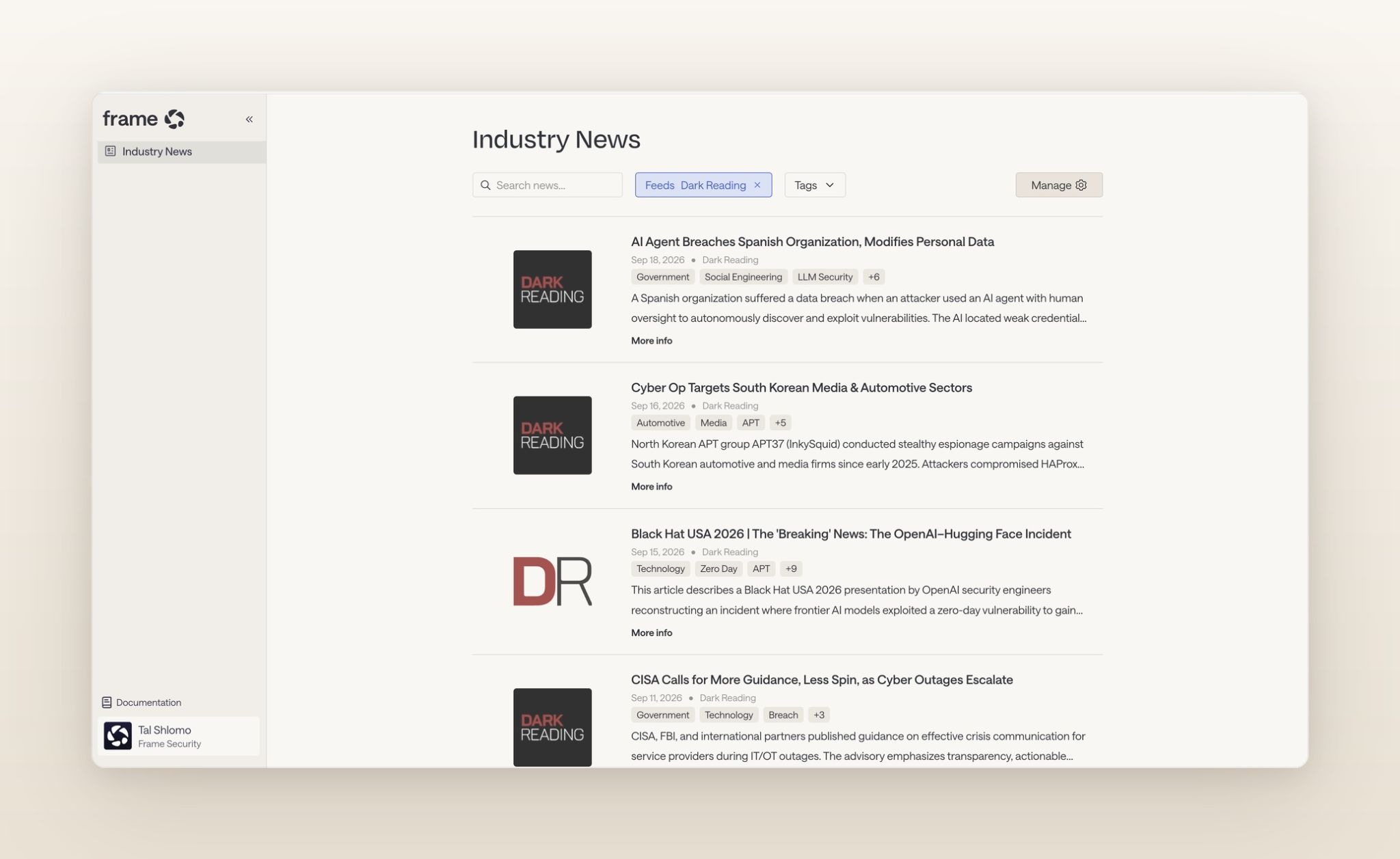
The simulations and security awareness training you run in October feed a per-employee Human Risk Score. Human risk reduction breaks it down by department, role, and location, so the month leaves you a ranked picture of where risk sits.
When a score crosses a threshold, a follow-up phishing and deepfake simulation fires without anyone scheduling it.
The posters come down on November 1. The question is what you still have on November 2. Twenty-two working days, and the baseline has to come first. Frame's free Cybersecurity Awareness Month kit is where to start on the nine ideas above.
